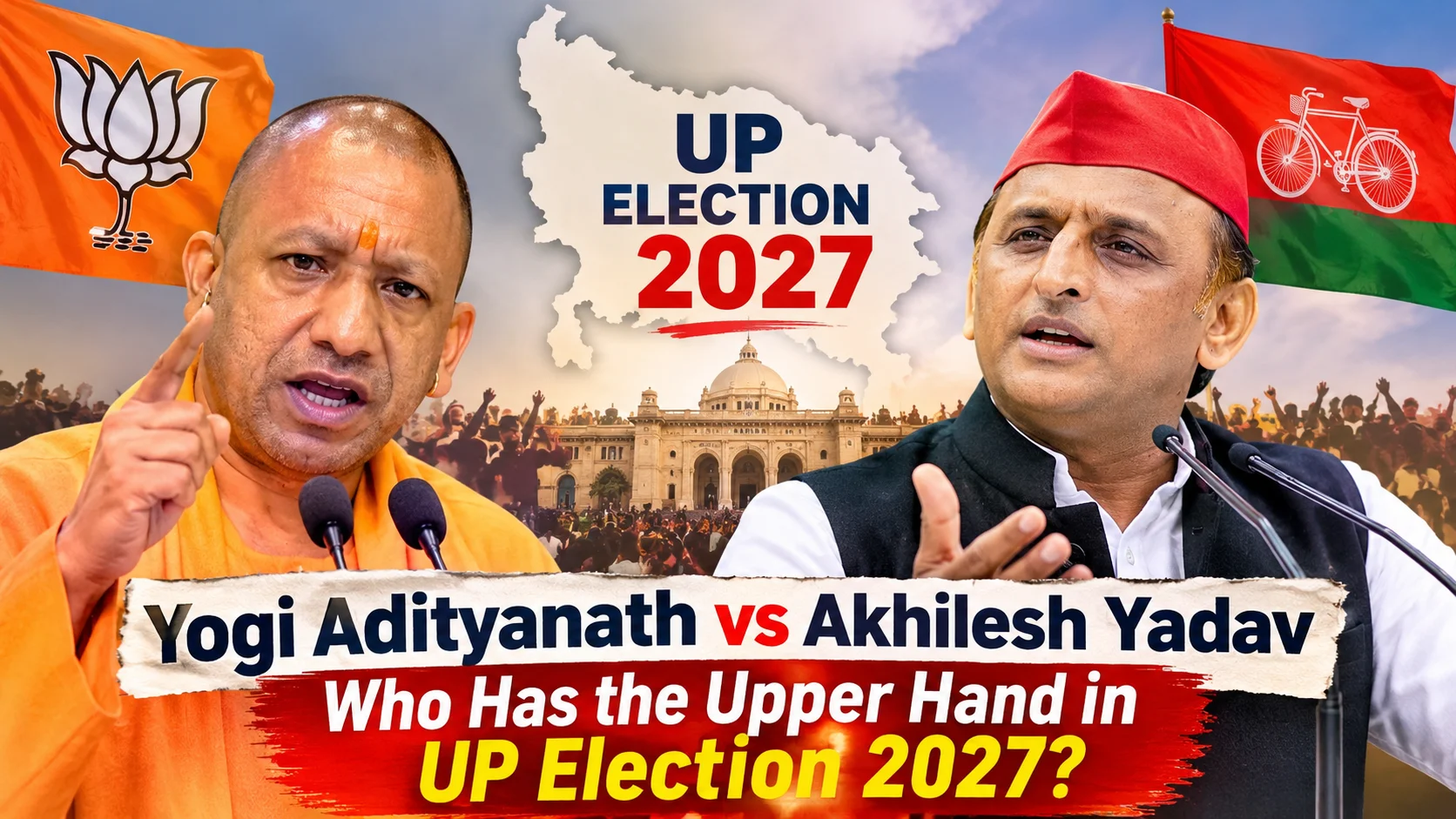
Uttar Pradesh politics is gradually moving towards another major electoral contest, and two familiar faces are once again at the centre of the discussion. Chief Minister Yogi Adityanath and Samajwadi Party president Akhilesh Yadav are preparing for a political battle that could shape the state’s future for the next five years.
The 2027 Uttar Pradesh Assembly election is particularly important for both leaders. Yogi Adityanath will be looking to defend the BJP government’s record after two consecutive terms in power, while Akhilesh Yadav will be seeking to convert the Samajwadi Party’s improved electoral performance into a renewed opportunity to govern the state.
The political atmosphere has already started changing. Recent developments, including Yogi Adityanath’s public challenge to Akhilesh Yadav to contest from Ayodhya, have added another dimension to the rivalry.
But this election will not be decided by political statements alone. Employment, inflation, farmers’ concerns, caste representation, development, law and order and the performance of local MLAs could all influence the final outcome.
So, what do the election numbers, recent political developments and voter surveys tell us about the contest between these two leaders?
2022 Assembly Election: How the Two Leaders Performed
To understand the 2027 political battle, it is important to revisit the 2022 Uttar Pradesh Assembly election.
The BJP secured 255 seats in the 403-member Assembly, while its allies helped the NDA take its total to 273 seats. The Samajwadi Party won 111 seats, significantly improving its position compared with the previous Assembly election.
The results showed two different political stories.
For Yogi Adityanath, the election marked the BJP’s return to power for a second consecutive term in Uttar Pradesh. He also became the first Chief Minister in decades to complete a full five-year term and return to office after an Assembly election.
For Akhilesh Yadav, the result demonstrated that the Samajwadi Party could regain considerable political ground, although it remained short of the numbers required to form the government.
The 2022 results therefore established the starting point for the next contest: an incumbent BJP government with a parliamentary majority in the state and an opposition party seeking to expand its electoral base.
2024 Lok Sabha Election Changed the Political Conversation
The 2024 Lok Sabha election brought a significant change to Uttar Pradesh’s political equation.
The Samajwadi Party won 37 of the state’s 80 parliamentary constituencies, while the BJP secured 33. Congress won six seats, and other NDA partners and parties secured the remaining seats.
The SP and Congress contested together as part of the INDIA alliance, and their combined performance became an important development in state politics.
For the BJP, the results raised questions about its organisational strategy, candidate selection and ability to retain support across different communities and constituencies.
For Akhilesh Yadav, the results provided an opportunity to strengthen his position as a major opposition leader.
However, parliamentary elections and Assembly elections are not identical. Voters may evaluate national leadership differently from state governance, and local candidates can play a significant role in determining constituency results.
The 2027 election will therefore test whether the political trends visible in 2024 continue at the state level.
Yogi Adityanath’s Political Strategy: Governance and Leadership
Yogi Adityanath’s political identity has become closely associated with the BJP’s governance model in Uttar Pradesh.
His administration has emphasised law and order, infrastructure development, investment, religious tourism and government welfare programmes.
The BJP’s political messaging has also placed considerable importance on the Chief Minister’s leadership and the continuity of its government.
One important advantage for an incumbent government is its ability to present an established record. It can highlight completed infrastructure projects, administrative decisions, investment announcements and welfare initiatives.
However, being in power also brings public scrutiny.
The opposition can question the government’s performance on employment, inflation, farmers’ concerns, education, healthcare and the delivery of public services.
A particularly important challenge for the BJP will be to distinguish satisfaction with the Chief Minister from satisfaction with individual MLAs. A voter may support the government’s leadership while still expressing dissatisfaction with their local representative.
This distinction could become relevant when the party selects candidates for the 2027 election.
Akhilesh Yadav’s Strategy: Expanding the Samajwadi Party’s Political Base
Akhilesh Yadav’s political strategy has increasingly focused on taking the Samajwadi Party beyond its traditional support base.
The party’s PDA framework, referring to Pichhde, Dalit and Alpsankhyak communities, has become an important part of its political messaging.
The strategy seeks to build a broader coalition by bringing together backward communities, Dalits and minorities.
The 2024 Lok Sabha results gave the SP an opportunity to demonstrate the electoral relevance of this approach.
However, sustaining a coalition across 403 Assembly constituencies is a different challenge. The party will need to maintain support among its traditional voters while building stronger relationships with communities that have not consistently supported it in previous elections.
The role of local leaders, candidate selection and coordination with alliance partners will also matter.
Akhilesh Yadav will have to address another important question: how can the SP translate its parliamentary election performance into a statewide Assembly-level political organisation?
Latest Opinion Poll: What Does the 2027 Survey Say?
An interesting indicator has emerged from the Vote Vibe State Vibe opinion poll tracker published on November 13, 2026.
The survey provides a snapshot of voter preferences ahead of the 2027 Assembly election.
According to the survey, Yogi Adityanath received 44.1% support as the preferred next Chief Minister, while Akhilesh Yadav received 34.5%.
However, the party-level voting intention figures show a much closer contest.
| Political party/alliance | Voting intention |
|---|---|
| BJP alliance | 41.9% |
| Samajwadi Party alliance | 39.1% |
| BSP | 6.4% |
| Others | 4.9% |
| Undecided | 7.8% |
The survey also asked respondents which party or alliance they thought would win the election. In that question, 42.2% identified the SP alliance, while 41.2% identified the BJP alliance.
These figures should not be interpreted as an election result or a reliable prediction. The reported gap between the two alliances is within the survey’s stated margin of error.
The poll used a telephonic methodology, covered respondents across Uttar Pradesh and reported a sample size of 8,339, with a stated margin of error of plus or minus three percentage points.
Its findings offer an interesting view of the current political environment, but further surveys and constituency-level research will be needed to understand voter preferences more comprehensively.
Unemployment and Inflation Could Become Major Election Issues
Political speeches and leadership contests may attract attention, but voters will also judge the election through everyday concerns.
The November 13 Vote Vibe survey identified unemployment as the most frequently mentioned election issue, with 26.5% of respondents selecting it.
Inflation followed at 16.3%, while farmers’ issues accounted for 11.3%.
Law and order and women’s safety received 9.9%, while education and healthcare accounted for 8.9%.
These figures highlight the range of issues that both political parties will need to address.
For the BJP, the challenge will be to explain its employment, investment and development record.
For the Samajwadi Party, the challenge will be to present credible alternatives and explain how its proposed policies would address the concerns of young people, farmers and households.
The election could therefore become an important discussion about the difference between political promises and measurable governance outcomes.
Caste Arithmetic and Regional Politics: The Importance of Local Equations
Uttar Pradesh’s electoral landscape is diverse. Political preferences can vary considerably between western Uttar Pradesh, Awadh, Purvanchal and Bundelkhand.
Both BJP and SP will need to understand these regional differences while preparing their candidate lists and campaign strategies.
The BJP has historically built a broad coalition that includes upper-caste voters, non-Yadav OBC communities and sections of Dalit voters.
The Samajwadi Party has traditionally drawn support from Yadavs and Muslims, while its PDA strategy seeks to expand its reach among other backward and Dalit communities.
The BSP also remains relevant to the discussion because its traditional Dalit support base could influence electoral competition in several constituencies.
The important question is not simply which party has a larger traditional support base. It is whether parties can maintain their existing voters while attracting additional support.
Even relatively small changes in voting patterns can have significant consequences in closely contested constituencies.
The Congress Factor: Will the Opposition Alliance Remain United?
Another important development ahead of the 2027 election is the relationship between the Samajwadi Party and Congress.
The two parties worked together in the 2024 Lok Sabha election as part of the INDIA alliance. Their coordination helped them contest the parliamentary election with a shared opposition platform.
However, seat-sharing discussions for the 2027 Assembly election have already encountered disagreements.
On November 26, 2026, reports indicated that negotiations had faced difficulties after the SP announced five candidates while discussions with Congress were still underway. Congress has reportedly sought a larger share of constituencies.
This disagreement does not automatically mean that the alliance will break down. Political negotiations often involve competing demands and constituency-level calculations.
Nevertheless, seat-sharing will be an important organisational test for the opposition.
If the parties agree on a common arrangement, they will need to coordinate their campaigns effectively. If disagreements continue, managing local contests could become more complicated.
For the BJP, the opposition’s ability to maintain coordination will be an important part of the broader electoral environment.
Yogi’s Ayodhya Challenge to Akhilesh: A New Political Dimension
The rivalry became more visible after Yogi Adityanath publicly challenged Akhilesh Yadav to contest the 2027 Assembly election against him from Ayodhya.
The statement has attracted attention because Ayodhya occupies an important place in Uttar Pradesh’s political and religious landscape.
It also reflects the increasingly personalised nature of the political contest between the two leaders.
However, a public challenge does not establish that either leader will contest from a particular constituency. Official candidate announcements and party decisions will determine the final picture.
The bigger question is whether the election will revolve around a direct leadership contest or remain focused on governance, local candidates and constituency-level issues.
Both leaders have reasons to make the campaign about their political records, but the final electoral contest will involve hundreds of candidates and a wide range of local concerns.
Yogi Adityanath vs Akhilesh Yadav: Key Political Differences
The two leaders represent different political approaches and organisational traditions.
| Political factor | Yogi Adityanath | Akhilesh Yadav |
|---|---|---|
| Party | BJP | Samajwadi Party |
| Political position | Chief Minister | Leader of Opposition |
| Main political platform | BJP’s governance and development agenda | PDA social coalition |
| 2022 Assembly result | BJP won 255 seats | SP won 111 seats |
| 2024 Lok Sabha result | BJP won 33 seats in UP | SP won 37 seats in UP |
| Major electoral challenge | Defending the government’s record | Converting opposition support into an Assembly majority |
| Key campaign questions | Governance, infrastructure, employment and law and order | Employment, social justice, representation and governance alternatives |
The comparison illustrates why the election cannot be understood through individual popularity alone. Both leaders will depend on their respective party organisations, alliances, candidates and the political issues that matter to voters.
What Could Shape the Final Electoral Equation in 2027?
Several developments will be important to watch as the election approaches.
1. Candidate selection: The performance and public image of individual candidates could influence results across closely contested constituencies.
2. Employment: Young voters’ concerns about jobs, recruitment and economic opportunities will remain important.
3. Opposition coordination: The final SP-Congress seat-sharing arrangement could influence the distribution of opposition votes.
4. Farmers and rural concerns: Agricultural income, infrastructure, electricity and rural employment will remain significant issues.
5. BSP’s role: The party’s electoral performance could influence contests in constituencies where its traditional support base remains relevant.
6. Government performance: Voters will evaluate the incumbent administration’s record and the opposition’s ability to offer credible alternatives.
7. Regional differences: Electoral preferences in western UP, Awadh, Purvanchal and Bundelkhand may not follow the same pattern.
The Bigger Question: Leadership vs Governance
The 2027 Uttar Pradesh Assembly election is shaping up as an important political contest between two leaders with different records, political platforms and organisational strengths.
Yogi Adityanath enters the election as the incumbent Chief Minister, with the BJP seeking to defend its government and present its record to voters.
Akhilesh Yadav enters the contest as the leader of the opposition, seeking to build on the Samajwadi Party’s parliamentary performance and broaden its political coalition.
The available survey data shows that both leaders and their parties have substantial support, but the figures also demonstrate why it would be premature to draw a definitive conclusion about the eventual result.
Ultimately, the election will be decided by voters across 403 constituencies. Leadership, local candidates, alliances, employment, inflation, development and governance will all contribute to the political debate.
For now, the most interesting feature of the 2027 contest is that the rivalry between Yogi Adityanath and Akhilesh Yadav is no longer just a comparison of two political personalities. It is also a test of two competing approaches to governance, social representation and the future direction of Uttar Pradesh.
The question for 2027 is not simply who commands greater political attention today, but how both leaders and their parties respond to the expectations of Uttar Pradesh’s voters.