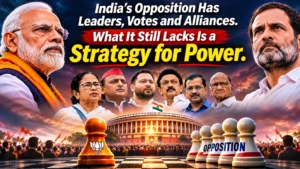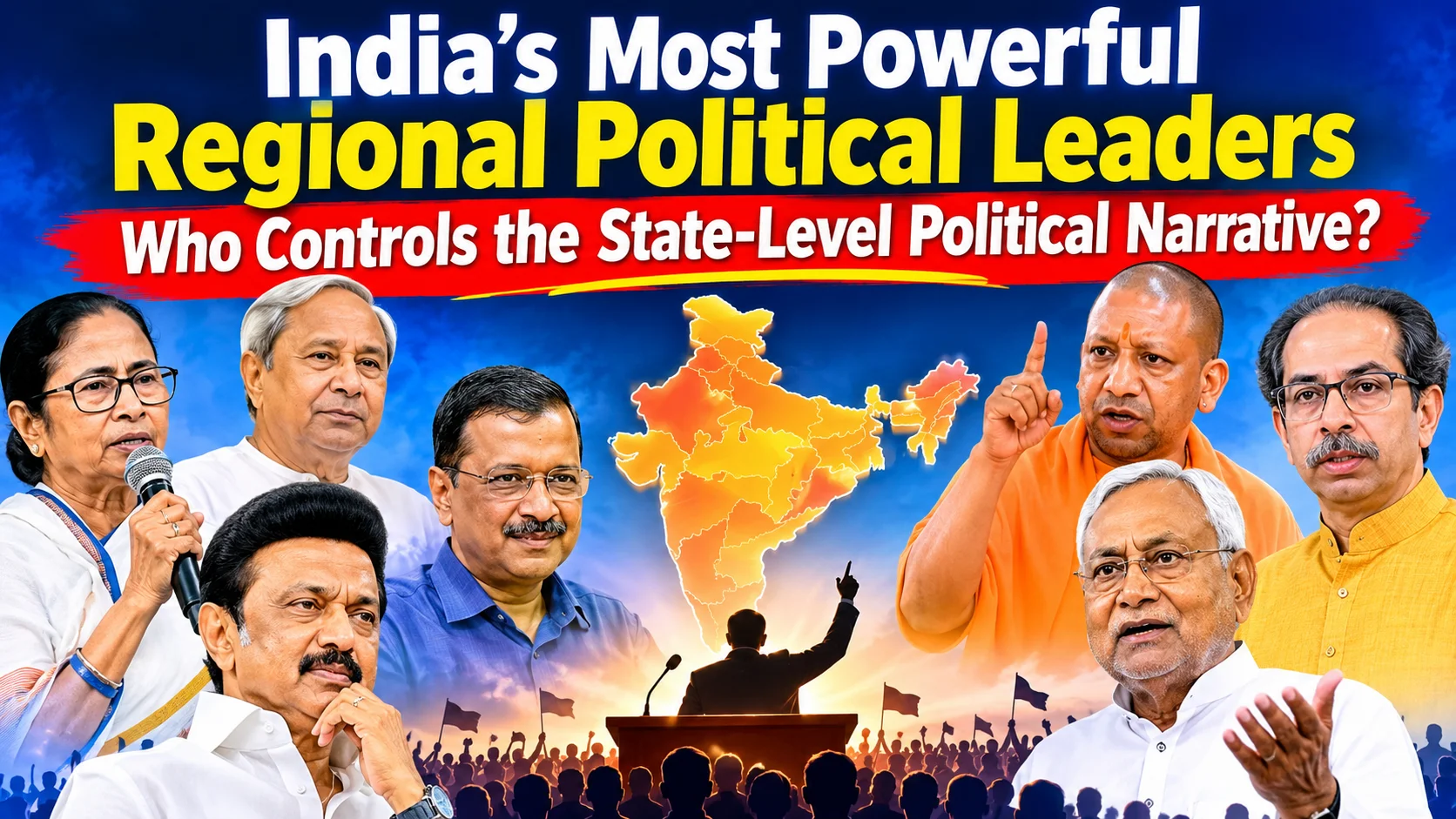
Indian politics is often discussed through the lens of national leadership, parliamentary elections and the major political parties. But much of the country’s political direction is shaped by leaders who command influence within individual states.
From Uttar Pradesh to Andhra Pradesh, Jharkhand to Punjab, regional leaders play an important role in determining government policies, electoral alliances, social representation and the relationship between state governments and the Centre.
Some have built their influence through regional political parties. Others lead state governments under national parties but have developed a distinct political identity within their states.
The 2024 Lok Sabha election demonstrated the importance of this political landscape. The BJP won 240 seats, while several regional parties secured substantial parliamentary representation. The Samajwadi Party won 37 seats, Trinamool Congress won 29, DMK won 22 and Telugu Desam Party secured 16.
These results showed that state-level political organisations continue to influence India’s national political arithmetic.
As political developments reshape state governments in 2026, several leaders deserve attention for their positions, organisational influence and role in shaping regional political debates.
1. Akhilesh Yadav – Uttar Pradesh’s Opposition Politics
Party: Samajwadi Party
State: Uttar Pradesh
Political position: Leader of the Opposition in Uttar Pradesh Assembly
Uttar Pradesh has one of the largest political arenas in India, with 403 Assembly constituencies and 80 Lok Sabha seats.
Akhilesh Yadav has emerged as one of the most prominent opposition leaders in the state. His political journey has involved leading the Samajwadi Party through electoral setbacks, organisational changes and attempts to expand its social coalition.
The 2024 Lok Sabha election became an important moment for his party. The Samajwadi Party won 37 parliamentary seats in Uttar Pradesh, ahead of the BJP’s 33.
One of the major elements of Akhilesh’s political strategy has been the PDA framework, which focuses on Pichhde, Dalit and Alpsankhyak communities.
The strategy seeks to build a broader coalition beyond the party’s traditional support base.
His influence also extends to national opposition politics. As the leader of a major regional party with substantial parliamentary representation, his position matters in discussions around opposition coordination, social justice and electoral alliances.
The 2027 Uttar Pradesh Assembly election will be an important political contest for the Samajwadi Party and its leadership.
2. N. Chandrababu Naidu – Andhra Pradesh’s Regional Political Power Centre
Party: Telugu Desam Party
State: Andhra Pradesh
Political position: Chief Minister of Andhra Pradesh
Chandrababu Naidu is among India’s most experienced regional political leaders.
His political career has included several terms as Andhra Pradesh Chief Minister and an important role in national coalition politics.
The Telugu Desam Party returned to power in Andhra Pradesh following the 2024 Assembly election. Its performance also helped establish Naidu’s position within the NDA at the national level.
The TDP won 16 Lok Sabha seats in 2024, making it an important parliamentary partner for the BJP-led government.
Naidu’s political agenda has traditionally focused on infrastructure, technology, investment, urban development and the economic development of Andhra Pradesh.
The state’s capital development question, industrial investment and infrastructure projects remain important subjects in the state’s political discussion.
His role is particularly relevant because the TDP combines state-level governing authority with parliamentary representation at the Centre.
This gives Andhra Pradesh a distinct position in national coalition politics.
3. Hemant Soren – Jharkhand’s Tribal and Regional Political Leadership
Party: Jharkhand Mukti Morcha
State: Jharkhand
Political position: Chief Minister of Jharkhand
Hemant Soren is an important figure in Jharkhand’s regional political landscape.
The Jharkhand Mukti Morcha has a long political history associated with tribal identity, regional autonomy and the state’s political formation.
Under Hemant Soren’s leadership, the party has continued to focus on tribal representation, land-related concerns, social welfare and the interests of Jharkhand’s indigenous communities.
The JMM-led alliance retained power in the 2024 Assembly election, allowing Hemant Soren to continue as Chief Minister.
Jharkhand’s political landscape is different from that of many larger states because tribal representation, mineral resources, land rights and regional identity remain important political subjects.
The state’s mining economy also creates significant governance questions around industrial development, employment, environmental protection and the distribution of economic benefits.
Hemant Soren’s political role is therefore closely connected to the wider debate about tribal representation and the relationship between natural resources and regional development.
4. Bhagwant Mann – AAP’s Political Face in Punjab
Party: Aam Aadmi Party
State: Punjab
Political position: Chief Minister of Punjab
Bhagwant Mann represents an important regional political experiment led by the Aam Aadmi Party.
AAP secured a decisive victory in the 2022 Punjab Assembly election, winning 92 of the state’s 117 seats.
Mann became Chief Minister following the party’s victory and has since remained its principal political face in Punjab.
The party’s political messaging has focused on education, healthcare, electricity, employment and public service delivery.
However, Punjab also faces several long-standing challenges, including agricultural concerns, drug-related problems, industrial development, public finances and youth migration.
The 2027 Assembly election will provide an important opportunity for voters to assess the government’s record.
Mann’s political influence will continue to be closely linked to AAP’s organisational strength, governance performance and its ability to maintain support across different regions of Punjab.
5. A. Revanth Reddy – Telangana’s Congress Leadership
Party: Indian National Congress
State: Telangana
Political position: Chief Minister of Telangana
Revanth Reddy has become a prominent political figure in southern India following Congress’s victory in the 2023 Telangana Assembly election.
His rise is particularly significant because Telangana politics had previously been dominated by the Bharat Rashtra Samithi under K. Chandrashekar Rao.
The Congress victory changed the state’s political arrangement and brought Revanth Reddy to the Chief Minister’s office.
His administration has focused on welfare commitments, agricultural support, employment, infrastructure and the implementation of the party’s electoral promises.
Telangana also has an important economic position because of Hyderabad’s technology, pharmaceutical, services and industrial sectors.
The relationship between economic development and welfare delivery remains an important part of the state’s political discussion.
Revanth Reddy’s political role also extends beyond Telangana because he represents Congress’s governing presence in an important southern state.
6. Omar Abdullah – Jammu and Kashmir’s Regional Political Leadership
Party: Jammu and Kashmir National Conference
Region: Jammu and Kashmir
Political position: Chief Minister
Omar Abdullah occupies an important position in Jammu and Kashmir’s political landscape.
The Jammu and Kashmir National Conference has a long history in the region and has played a major role in its political development.
The 2024 Assembly election was particularly significant because it marked the first Assembly election in the Union Territory following the 2019 constitutional and administrative changes.
The National Conference emerged as the largest party and formed the government with Congress support.
Omar Abdullah’s administration operates within a political and constitutional framework different from that of a full-fledged state government.
Restoration of statehood, employment, public services, tourism and the relationship between the elected government and the Lieutenant Governor remain important subjects in the region’s political debate.
His political role is closely connected to regional representation and the future of democratic governance in Jammu and Kashmir.
7. Conrad K. Sangma – Meghalaya’s Coalition Politics
Party: National People’s Party
State: Meghalaya
Political position: Chief Minister of Meghalaya
Conrad Sangma represents the importance of regional parties in India’s northeastern states.
The National People’s Party has built its political organisation across parts of Northeast India, with Meghalaya serving as its principal political base.
Sangma has led Meghalaya’s government since 2018, navigating coalition arrangements and the state’s distinct political and social environment.
His political agenda includes infrastructure development, tourism, education, employment and the economic opportunities available to northeastern communities.
The Northeast has a unique political landscape in which regional identity, community representation, development concerns and relations with the Centre frequently shape electoral discussions.
Sangma’s position is therefore relevant not only to Meghalaya but also to the wider political relationships among northeastern states.
8. Prem Singh Tamang – Sikkim’s Regional Political Leadership
Party: Sikkim Krantikari Morcha
State: Sikkim
Political position: Chief Minister of Sikkim
Prem Singh Tamang, popularly known as P. S. Golay, is a prominent regional leader in the Himalayan state of Sikkim.
His party, the Sikkim Krantikari Morcha, secured a major victory in the 2024 Assembly election, winning 31 of the state’s 32 seats.
The result demonstrated the strength of the party’s regional political organisation.
Sikkim’s political priorities include tourism, infrastructure, employment, environmental protection and the development of a geographically sensitive Himalayan economy.
The state’s relatively small Assembly and distinct political environment mean that local leadership and community relationships have considerable importance.
Tamang’s political position also demonstrates how regional parties can maintain strong state-level organisations despite having limited parliamentary representation.
9. Yogi Adityanath – Uttar Pradesh’s State-Level Political Influence
Party: Bharatiya Janata Party
State: Uttar Pradesh
Political position: Chief Minister of Uttar Pradesh
Although Yogi Adityanath leads a national political party, his role in Uttar Pradesh politics goes beyond the position of a conventional state-level party leader.
He has served as Chief Minister since March 2017 and completed a second consecutive term following the BJP’s 2022 Assembly victory.
His administration has placed emphasis on law and order, infrastructure, investment, religious tourism and welfare delivery.
Uttar Pradesh’s political significance is considerable because of its 80 Lok Sabha constituencies and its influence on national parliamentary arithmetic.
Yogi Adityanath’s political identity is also connected to his public messaging, governance decisions and the BJP’s electoral organisation in the state.
The 2027 Assembly election will be an important occasion for voters to evaluate the government’s record and the competing political programmes presented by the BJP and opposition parties.
10. C. Joseph Vijay – Tamil Nadu’s New Political Chapter
Party: Tamilaga Vettri Kazhagam
State: Tamil Nadu
Political position: Chief Minister of Tamil Nadu
Tamil Nadu has a long history of regional political leadership, with Dravidian parties playing a central role in its electoral politics.
The political landscape entered a new phase in May 2026 when actor-politician C. Joseph Vijay became Chief Minister following the TVK’s Assembly election victory.
His rise represents an important development in Tamil Nadu’s political history and introduces a new political organisation into the state’s governing structure.
TVK’s emergence has changed the established political arrangement involving the DMK and AIADMK.
The new government faces questions around employment, education, industrial development, welfare programmes, state autonomy and the implementation of its electoral commitments.
Vijay’s political position will be closely connected to the ability of TVK to develop a durable party organisation and translate its electoral mandate into administrative outcomes.
Tamil Nadu will remain an important example of how regional political movements can reshape established party systems.
How Regional Leaders Influence National Politics
The influence of regional political leaders does not end at state borders.
Their parliamentary strength, relationships with coalition partners and positions on national policy can affect discussions in New Delhi.
The 2024 Lok Sabha results demonstrated this clearly.
| Party | Leader | Lok Sabha seats won in 2024 |
|---|---|---|
| Samajwadi Party | Akhilesh Yadav | 37 |
| Trinamool Congress | Mamata Banerjee | 29 |
| DMK | M. K. Stalin | 22 |
| Telugu Desam Party | N. Chandrababu Naidu | 16 |
| JD(U) | Nitish Kumar | 12 |
| Shiv Sena (UBT) | Uddhav Thackeray | 9 |
| NCP (SP) | Sharad Pawar | 8 |
| AAP | Arvind Kejriwal | 3 |
These are historical 2024 election results, not current party-strength figures or a ranking of present-day leaders.
They illustrate how state-based political organisations can influence national parliamentary arrangements.
What Gives a Regional Political Leader Influence?
Political influence cannot be measured through one election result or a leader’s public profile alone.
Several factors contribute to the role of a regional leader.
1. Electoral representation: The number of Assembly and parliamentary constituencies represented by a party provides an indication of its electoral reach.
2. Organisational strength: A party’s district-level network, local leadership and ability to mobilise supporters are important elements of regional politics.
3. Government leadership: A Chief Minister has direct responsibility for state administration, public services and policy implementation.
4. Social representation: Regional parties often build their political identities around language, community representation, regional autonomy and local economic interests.
5. Coalition relationships: Leaders of regional parties can influence national political arrangements through their parliamentary representation and alliance relationships.
6. Public policy: Positions on employment, agriculture, education, healthcare and federal relations can shape political debates beyond a leader’s home state.
Regional Politics Is Changing Across India
The political environment of 2026 is different from that of the 2024 general election.
Changes in state governments have altered the positions of several established leaders and parties.
Tamil Nadu now has a TVK-led government under Joseph Vijay. West Bengal has a BJP government under Suvendu Adhikari, following the end of Mamata Banerjee’s tenure. Bihar has a BJP-led government under Samrat Choudhary after Nitish Kumar’s departure from the Chief Minister’s office.
These changes demonstrate that political influence is not permanent. Established leaders can lose office, new parties can emerge and political organisations can change their electoral strategies.
At the same time, leaders such as Chandrababu Naidu, Hemant Soren, Bhagwant Mann and Akhilesh Yadav continue to occupy important positions in their respective political environments.
For observers of Indian politics, the important task is to understand these changes without treating historical influence as a guarantee of future electoral strength.
Conclusion: India’s Political Story Is Also a Story of Its States
India’s political system is shaped by the interaction between national parties, regional organisations and state-level leadership.
Akhilesh Yadav’s role in Uttar Pradesh, Chandrababu Naidu’s coalition politics in Andhra Pradesh, Hemant Soren’s regional leadership in Jharkhand and Bhagwant Mann’s administration in Punjab represent different forms of political influence.
Meanwhile, new developments in Tamil Nadu and changes in governments elsewhere demonstrate how quickly the regional political landscape can evolve.
Regional leaders influence more than election campaigns. Their decisions affect state policies, regional development, social representation and the relationship between state governments and the Union government.
Understanding Indian politics therefore requires looking beyond Parliament and national leadership. The political direction of India is also shaped by the leaders, parties and movements that represent its individual states.