The opposition’s problem is not simply unity. It is the inability to turn regional political strength into a national electoral advantage.
India’s opposition is often judged through a familiar lens: leadership, unity, alliances and seat-sharing. These are important, but they barely scratch the surface of the challenge.
The real question is whether India’s opposition understands how power is accumulated, protected and transferred in a national election.
The BJP is not merely competing against individual political parties. It operates within a national political framework built around leadership, organisation, messaging, electoral machinery and the ability to connect local contests to a broader national narrative.
The opposition, meanwhile, possesses significant political assets—but those assets often operate independently.
That is the fundamental imbalance.
1. The Opposition Is Not Weak Everywhere. It Is Weak at Converting Strength.
The opposition’s biggest misconception may be that its electoral strength can simply be added together.
A party winning in West Bengal, another performing strongly in Uttar Pradesh and a third dominating Tamil Nadu does not automatically create a national alternative.
Political strength is geographically concentrated. Voter motivations are different. Leadership appeal is not transferable. A party’s success in one state does not guarantee its relevance in another.
This is where arithmetic becomes misleading.
A combined vote share may look impressive on paper, but elections are fought constituency by constituency. Votes do not move automatically between alliance partners, and voters do not necessarily accept political arrangements made by party leadership.
The opposition needs something more sophisticated than addition.
It needs electoral conversion—the ability to convert individual party strengths into victories in constituencies where those strengths overlap or complement each other.
That requires identifying where a party is genuinely competitive, where it is merely present, and where its participation could weaken a stronger alliance partner.
The distinction between political presence and electoral strength could determine the outcome of hundreds of decisions before 2029.
2. The BJP’s Advantage Is Not Just Votes. It Is the Ability to Define the Election.
Elections are not fought only over candidates. They are fought over what voters believe the election is about.
A national party with a strong central leadership can attempt to make a local constituency election part of a larger national story. Local candidates become connected to national leadership, national issues and a broader political identity.
The opposition frequently faces the reverse problem.
Its strongest leaders are often regional. Their political credibility is built around local identity, state-level governance, regional issues and their ability to challenge a particular political force.
That is a strength—but it can become a limitation when the opposition tries to construct a national narrative.
The challenge is not to erase regional leadership. It is to connect regional political successes to a national proposition.
If a voter sees the opposition as a collection of state-level alternatives but not as a credible national governing force, the alliance may remain electorally competitive without becoming politically dominant.
Winning individual states and convincing India to choose an alternative government are two different political exercises.
3. The Seat-Sharing Formula Is More Complicated Than It Looks
Seat-sharing is usually discussed as a negotiation between parties. In reality, it is a calculation involving power, survival, reputation and future political relevance.
A party may demand more seats not because it expects to win all of them, but because reducing its electoral footprint could weaken its bargaining position after the election.
Another party may refuse to surrender constituencies because its local organisation, cadre and future expansion depend on contesting them.
This creates a difficult strategic problem.
The party with the strongest local candidate may not always be the party with the strongest alliance. A regional party may be capable of winning a seat independently but unwilling to surrender it to a partner. Meanwhile, an alliance may lose the constituency because both parties consider the seat too important to compromise.
The cost of such disputes is not limited to losing a few seats.
It can create resentment among workers, damage local organisation, weaken campaign coordination and make voters question the credibility of the alliance.
A successful alliance therefore requires more than a seat-sharing formula.
It requires a system for resolving disputes, measuring constituency strength and accepting electoral compromises without creating political casualties inside the alliance.
4. Regional Parties May Be Kingmakers—But They Also Have Something to Lose
Regional parties are often described as the opposition’s biggest asset. That is true, but the relationship is more complicated.
Regional parties have their own political objectives. Their priority may be protecting power in their state, maintaining control over their political identity, expanding their organisation or preventing a national party from replacing them.
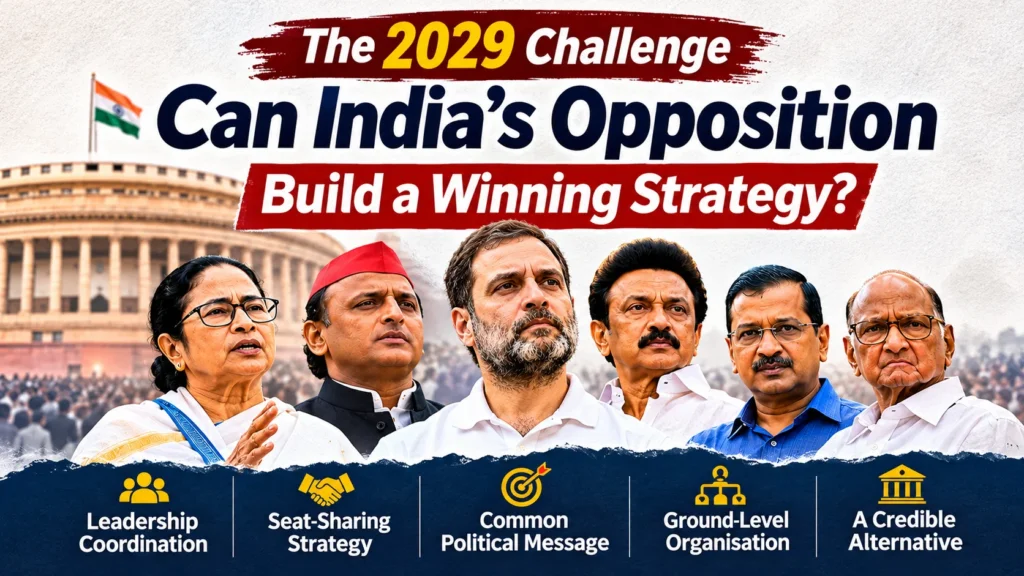
Their interests may align with a national opposition alliance during a parliamentary election but diverge when the alliance begins discussing leadership, governance or national policy.
This is not necessarily a failure of political cooperation. It is the natural behaviour of parties competing for their own survival.
The opposition’s strategic challenge is to build an alliance in which cooperation does not require political surrender.
Regional leaders must see value in the alliance beyond the immediate election. They must believe that their political influence will survive if the alliance succeeds.
India’s regional parties remain important precisely because national politics cannot completely absorb the country’s diverse political identities. Their future relevance is tied to regional aspirations, federal politics and state-level political competition.
The opposition needs to understand this reality rather than treating regional parties as numbers to be assembled before an election.
5. The Leadership Question Is Not About Who Is More Popular
The opposition’s leadership debate is often reduced to one question: Who should lead?
But the more important question is: Who has the authority to make difficult decisions when alliance interests collide?
A coalition can have several prominent leaders. That does not necessarily make it weak. In fact, India’s political diversity makes collective leadership a potentially workable model.
The problem begins when collective leadership becomes collective indecision.
Who decides the candidate in a difficult constituency? Who resolves a dispute between two major alliance partners? Who determines the national campaign message? Who takes responsibility when an alliance loses? Who can ask a powerful regional leader to compromise—and expect that compromise to be accepted?
These are institutional questions, not popularity contests.
The opposition does not necessarily need to identify one leader who dominates everyone else. It needs a political structure where decisions can be made without turning every disagreement into a public confrontation.
Leadership without authority creates confusion. Authority without acceptance creates rebellion.
The opposition needs both legitimacy and a decision-making mechanism.
6. The Opposition Is Fighting the BJP. But Is It Building Its Own Political Identity?
One of the most difficult challenges for any opposition is avoiding political dependence on the ruling party’s agenda.
If the BJP sets the national conversation and the opposition spends most of its political energy reacting, it risks becoming a participant in a campaign designed by its opponent.
Every election then becomes a referendum on the BJP.
That may work in certain circumstances, particularly when anti-incumbency is strong. But it becomes difficult to sustain when the ruling party retains its own political narrative, leadership appeal and voter base.
The opposition needs to create issues that define its own political identity.
Not every issue needs to be a reaction. Not every speech needs to be a rebuttal. Not every campaign needs to revolve around the same political personalities.
A serious national alternative must be able to tell voters what it stands for independently of whom it opposes.
The strategic difference is significant.
An opposition that reacts can challenge power. An opposition that defines the agenda can compete to replace it.
7. The Electoral Map May Matter More Than the National Mood
National political discussions often focus on popularity, approval, rallies and political momentum.
But parliamentary elections are ultimately decided through individual constituencies.
A party can improve its national vote share and still fail to translate that increase into a proportional number of seats. Conversely, a carefully targeted alliance can gain substantial parliamentary strength without dominating the national vote.
This is why the opposition needs a constituency-level strategy rather than merely a national campaign.
It must identify:
-
Constituencies where the BJP is vulnerable.
-
Seats where opposition votes are divided.
-
Constituencies where regional parties have genuine local dominance.
-
Seats where candidate selection could matter more than national sentiment.
-
Constituencies where an alliance partner has little electoral presence.
-
Seats where a small vote shift could change the result.
The real strategic question is not how many constituencies the opposition wants to contest.
It is how many constituencies it can realistically win—and how it can avoid wasting political capital in seats where its chances are limited.
A targeted electoral strategy may be far more valuable than an ambitious but poorly coordinated national campaign.
8. The Opposition’s Biggest Asset Could Also Become Its Biggest Weakness
India’s opposition is diverse. That diversity gives it access to different voter groups, regional identities and political networks.
But diversity without coordination creates fragmentation.
Different parties may have different views on economic policy, leadership, federalism, welfare, foreign policy and the role of regional politics. These differences do not necessarily prevent an alliance from functioning.
The danger is pretending they do not exist.
A coalition that avoids difficult conversations before an election may be forced to confront them after winning.
The opposition must therefore answer a question that is rarely discussed seriously enough:
What happens the morning after the election?
Who governs? How are ministries allocated? How are policy disagreements resolved? How does the coalition maintain stability when its partners have competing political interests?
A credible alternative government cannot be built exclusively around an electoral agreement.
It needs a minimum governing framework.
The absence of such a framework may not prevent parties from contesting together, but it could affect how voters perceive the alliance’s ability to govern.
9. The BJP’s Weaknesses Will Not Automatically Become the Opposition’s Strengths
This is perhaps the most important distinction in opposition politics.
If voters become dissatisfied with the government, that does not automatically mean they are ready to support the opposition.
Dissatisfaction creates an opportunity. Political organisation, credibility and leadership determine who benefits from it.
The opposition cannot assume that inflation, unemployment, local dissatisfaction or anti-incumbency will automatically translate into votes for its alliance.
There is always the possibility that dissatisfied voters abstain, support a regional party, choose an independent candidate or continue voting for the ruling party despite reservations.
The opposition therefore needs to do two things simultaneously:
-
Identify and amplify genuine areas of voter dissatisfaction.
-
Build a credible alternative that gives dissatisfied voters a reason to switch.
The second task is harder.
Winning the argument against the government and winning the confidence of voters are not the same thing.
10. The 2029 Election Could Be Decided Before the Campaign Begins
By the time national campaigning begins, much of the opposition’s electoral fate may already be influenced by decisions taken behind closed doors.
Alliance formation, constituency negotiations, candidate selection, state-level coordination, organisation building and leadership arrangements will shape the contest long before campaign speeches dominate television.
The opposition’s biggest opportunity is to treat the period before the election as a strategic preparation phase—not merely a waiting period.
It needs to establish:
-
A realistic map of competitive constituencies.
-
A mechanism for alliance decisions.
-
Early candidate identification.
-
Coordinated state-level campaigns.
-
A national narrative that complements regional strengths.
-
A credible governing framework.
The opposition does not need to win every political argument.
It needs to win the right constituencies, avoid preventable losses and make its political strengths work together.
The Real Question: Can the Opposition Think Like a National Power, Not Just an Electoral Alliance?
The opposition’s challenge before 2029 is not simply to bring political leaders together. It is to build a system where regional strengths, national leadership, electoral strategy and political messaging operate in the same direction.
The BJP’s advantage is that it has spent years building a political structure that connects national politics with state-level contests. Challenging that structure requires more than periodic alliance meetings or joint rallies.
It requires planning, discipline, political compromises and a clear understanding of where power can actually be won.
The opposition may not need to agree on everything. It needs to agree on what matters most.
In Indian politics, alliances are often built around the fear of losing. The more durable ones are built around a shared understanding of how to win—and what to do with power once it is won.
The 2029 question is not whether India’s opposition can unite. It is whether it can transform its fragmented political strength into a coherent strategy for power.
That may ultimately be the difference between an alliance that contests an election and an alliance that changes its outcome.