
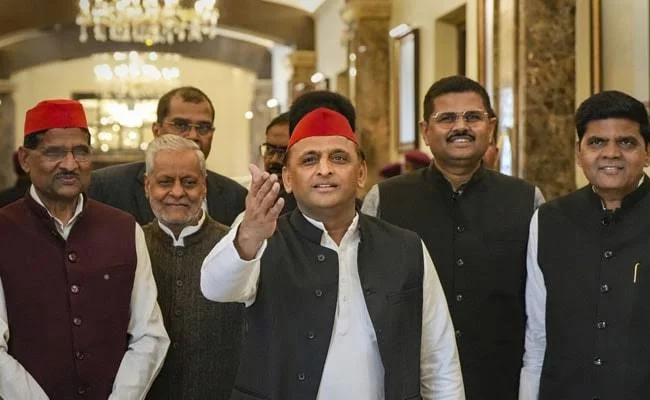
Lucknow: Samajwadi Party president Akhilesh Yadav has initiated a strategic recalibration of his party’s signature ‘PDA’ campaign framework to court upper-caste voters in Uttar Pradesh. While the move aims to broaden the party’s social coalition beyond its traditional base, political observers suggest that mere rhetorical shifts will face significant hurdles in convincing these demographic groups.
Strategic Recalibration of the PDA Blueprint
The Samajwadi Party (SP), under the leadership of former Uttar Pradesh Chief Minister Akhilesh Yadav, has begun reframing its central political coalition strategy, popularly known as the ‘PDA’ framework. Originally conceptualized to represent Pichhde (Backward Classes), Dalit, and Alpasankhyak (Minorities), the alliance formed the bedrock of the party’s recent electoral campaigns in Uttar Pradesh. In a bid to construct a wider social coalition, Yadav has increasingly redefined the narrative to integrate upper-caste communities into the fold, seeking to present his party as an all-inclusive political vehicle for socio-economic justice.
Challenging the Dominant Electoral Coalitions
The original PDA formulation yielded significant dividends for the Samajwadi Party by consolidating backward groups, Dalit factions, and minority votes. However, political strategists within the party acknowledge that capturing power in Uttar Pradesh requires penetrating the formidable upper-caste vote bank, which has largely backed the ruling Bharatiya Janata Party (BJP) over the past decade. By expanding the scope of PDA to include aggrieved or economically disadvantaged members of upper castes, Yadav seeks to fracture the BJP’s traditional support base across key regional constituencies.
Analytical Perspective: Rhetoric versus Ground Reality
Despite the strategic push, political analysts and independent observers remain skeptical regarding the overall effectiveness of this revised campaign strategy. Analysts emphasize that altering deeply entrenched voting patterns demands far more than rhetorical adjustments or public declarations. Upper-caste voters in Uttar Pradesh have historically aligned with the BJP due to aligned ideological priorities, strong organizational machinery, and prominent leadership representation.
Political commentators argue that for the Samajwadi Party to earn genuine trust among upper-caste voters, it must back its rhetoric with tangible measures. These include proportional candidate selection, structural representation within the party hierarchy, and explicit policy promises that address their economic concerns. Without these concrete steps, analysts warn that the expanded PDA pitch risks being viewed merely as temporary political posturing.
Balancing Core Constituencies with New Outreach
Furthermore, Yadav faces a delicate balancing act within his own political base. Broadening the party’s focus to woo upper-caste voters could potentially trigger friction among its foundational Backward and Dalit supporters, who have traditionally competed against upper-caste dominance in local power structures. Managing these internal contradictions will prove critical for the Samajwadi Party as it attempts to solidify its political footprint in Uttar Pradesh ahead of forthcoming electoral battles.