1. The Legislative Architecture of the Republic of India
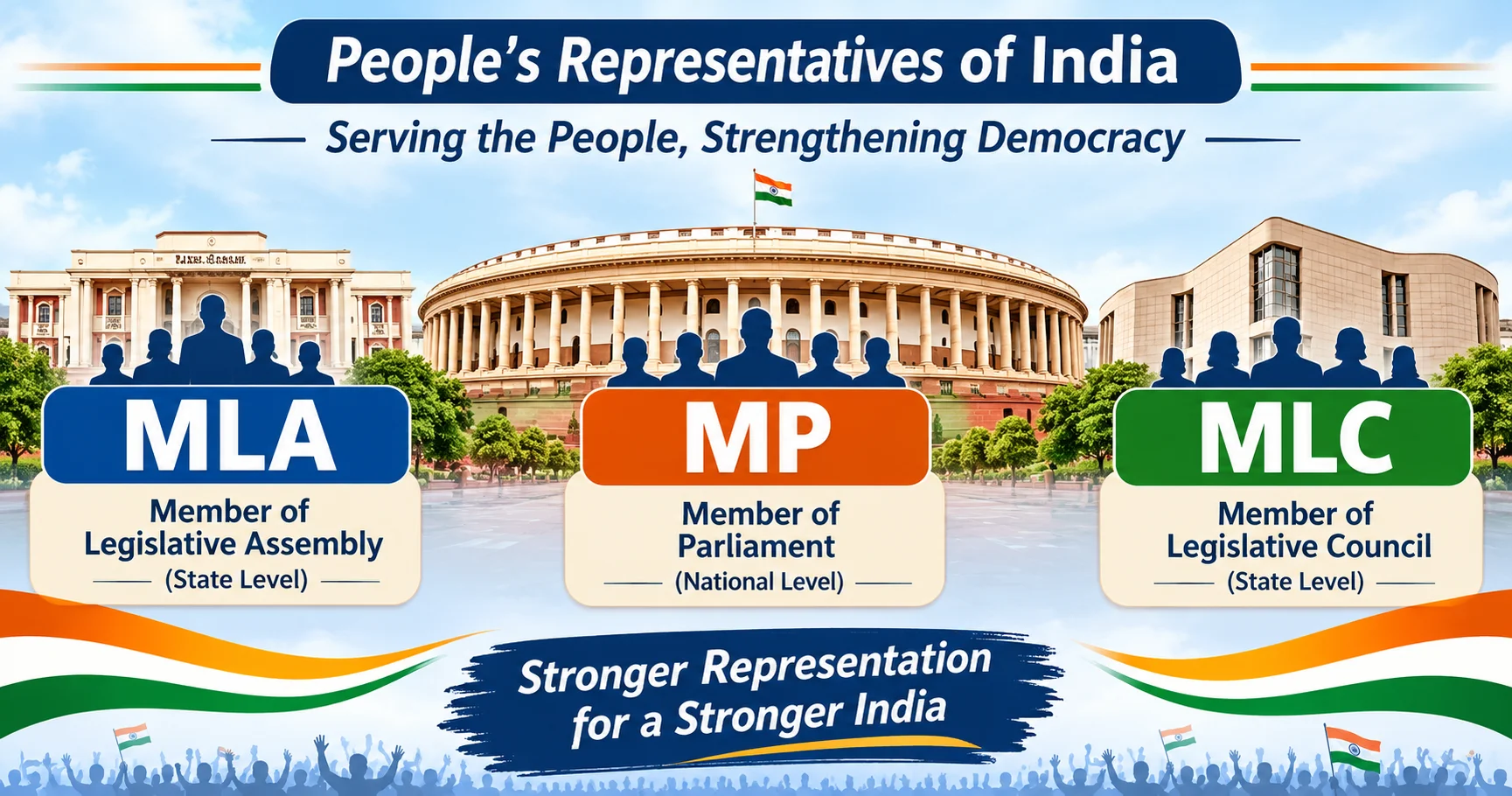
India operates under a quasi-federal constitutional democracy established by the Constitution of India in 1950. Power is distributed between the Union Government and State Governments under the Seventh Schedule (Union List, State List, and Concurrent List). To represent citizens across these governance spheres, India elects lawmakers to different constitutional chambers:
- Members of Parliament (MPs): Legislate at the national level in Parliament (Lok Sabha – House of the People, and Rajya Sabha – Council of States).
- Members of Legislative Assembly (MLAs): Legislate at the state level in the Vidhan Sabha (State Legislative Assembly).
- Members of Legislative Council (MLCs): Serve in the Vidhan Parishad (State Legislative Council), the upper chamber present in select states.
2. Comparative Matrix: MP vs. MLA vs. MLC
| Feature / Dimension | Member of Parliament (MP) | Member of Legislative Assembly (MLA) | Member of Legislative Council (MLC) |
|---|---|---|---|
| Legislative Chamber | Parliament (Lok Sabha / Rajya Sabha) | Vidhan Sabha (Assembly) | Vidhan Parishad (Council) |
| Governance Tier | Union / National Government | State Government | State Government |
| Constitutional Basis | Articles 79–122 of the Constitution | Articles 168–212 of the Constitution | Articles 168–212 of the Constitution |
| Election Mode | Direct (LS) / Indirect by MLAs (RS) | Direct universal adult franchise | Indirect / Nominated by Governor |
| Constituency Scope | Large (encompasses 5 to 9 Assembly seats) | Single assembly constituency | Elected by Local Authorities/Graduates/MLAs |
| Local Development Fund | MPLADS: ₹ 5.00 Crore per year | MLALADS: ₹ 2.00–5.00 Crore per year | Eligible under state MLALADS |
| Minimum Age Requirement | 25 Years (LS) / 30 Years (RS) | 25 Years | 30 Years |
| Legislative Term | 5 Years (LS) / 6 Years (RS) | 5 Years (unless dissolved earlier) | 6 Years (1/3rd retire every 2 years) |
3. Constitutional Powers, Legislative Functions & Jurisdictional Scope
The division of powers between an MP, MLA, and MLC is defined by the Constitution of India:
A. Powers of a Member of Parliament (MP)
MPs legislate on Union List subjects, including National Defence, Foreign Affairs, Railways, Banking, Atomic Energy, and Income Taxation. They hold sovereign power to amend the Constitution (Article 368), approve Union Budgets, and introduce motions of no-confidence against the Union Council of Ministers.
B. Powers of a Member of Legislative Assembly (MLA)
MLAs legislate on State List subjects, including Police and Public Order, Public Health and Sanitation, Agriculture, Water Supplies, and Land Revenue. MLAs hold the power to pass state budgets and hold the Chief Minister and State Cabinet accountable.
C. Powers of a Member of Legislative Council (MLC)
MLCs function as an advisory and revisionary chamber, reviewing legislation passed by the Assembly, providing technical expertise, and delaying non-money bills for reconsideration.
4. Salaries, Allowances & Official Amenities
Remuneration for Indian lawmakers is determined by respective parliamentary and state assembly acts:
- Members of Parliament: Governed by the Salary, Allowances and Pension of Members of Parliament Act, 1954. Includes basic salary, constituency allowance, office expense allowance, daily sessional allowance, official residence in New Delhi, and travel entitlements.
- Members of Legislative Assembly: Set independently by each state legislature. Basic salaries and allowances vary substantially across states, ranging from ₹ 1.00 Lakh to ₹ 2.50 Lakh per month.
Frequently Asked Questions (FAQs)
Which is more powerful: an MP or an MLA in India?
Both hold constitutional authority within their designated jurisdictions. MPs legislate on national matters (Union List), while MLAs legislate on vital local and state matters (State List, such as Police, Health, and Land).
Can an individual serve as both an MP and an MLA simultaneously?
No. Under the Prohibition of Simultaneous Membership Rules, 1950, a representative elected to both Parliament and a State Legislature must resign from one seat within 14 days, failing which their parliamentary seat becomes vacant.
Do all Indian states have a Legislative Council (Vidhan Parishad)?
No. Only six Indian states currently have a bicameral legislature with a Legislative Council: Uttar Pradesh, Bihar, Maharashtra, Karnataka, Andhra Pradesh, and Telangana.
What is the Local Area Development Fund allocated to an MP and MLA?
MPs receive ₹ 5.00 Crore annually under the MPLADS scheme. MLAs receive funds under their respective state MLALADS schemes, typically ranging between ₹ 2.00 Crore and ₹ 5.00 Crore annually.
Mandatory Transparency Notice: Financial figures cited in this publication are compiled directly from sworn legal affidavits (Form 26) filed before the Election Commission of India pursuant to Rule 4A of the Conduct of Elections Rules, 1961 and Supreme Court transparency directives (Union of India v. Association for Democratic Reforms, 2002). Self-declared assets reflect candidate statements under penalty of perjury and do not constitute independently audited commercial net worth.