India’s next general election is still years away, but the political contest of 2029 is already taking shape. Not necessarily through campaign slogans or election rallies, but through decisions being made today about alliances, leadership, state politics, economic priorities and the organisation of political parties.
The temptation is to begin predicting numbers. How many seats will the BJP win? Can the opposition form a government? Will regional parties become kingmakers again? Will the political momentum of 2024 continue—or reverse?
But these questions may be premature.
India’s 2024 general election demonstrated how quickly political expectations can collide with electoral reality. The Bharatiya Janata Party (BJP) emerged as the largest party with 240 Lok Sabha seats, falling short of an outright majority. The National Democratic Alliance (NDA), however, secured a majority and formed the government. Meanwhile, the Congress won 99 seats, while the opposition INDIA alliance secured 234 seats.
The result did not produce a complete political transformation. But it changed the calculations.
Coalition partners became more consequential. Opposition parties gained renewed relevance. Regional political forces demonstrated that national political momentum does not automatically translate into uniform electoral success across the country.
That is why predicting 2029 today may be less useful than understanding the scenarios that could shape it.
The next election could be a continuation of the present political order, a more competitive contest between alliances, a collection of state-level battles, a referendum on economic conditions—or something nobody currently anticipates.
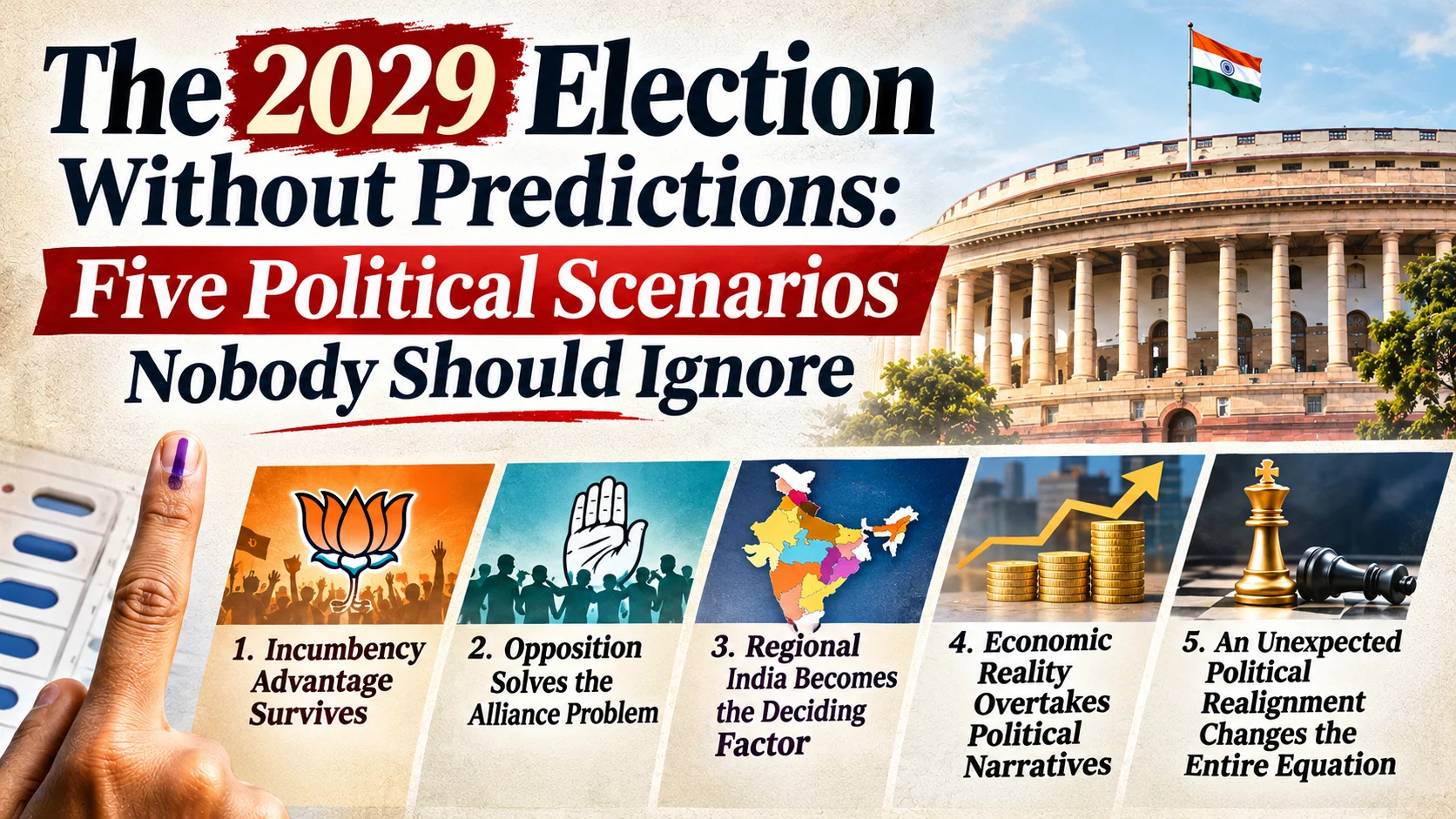
These five possibilities deserve attention.

Scenario 1: The Incumbency Advantage Survives
The ruling alliance enters 2029 with its political machinery intact
One possibility is that the political advantages accumulated by the ruling alliance continue to outweigh the pressures it faces.
India’s national politics is not shaped by electoral dissatisfaction alone. Leadership appeal, welfare delivery, infrastructure, political organisation, national security messaging, ideological mobilisation and the ability to communicate a coherent political narrative can all influence voter decisions.
The BJP remains India’s most powerful national political organisation in terms of its parliamentary presence. Its 2024 result, although below its previous majority, did not eliminate its central position in national politics. The NDA’s ability to secure a majority also demonstrated the continuing importance of coalition partners.
The political question is whether the ruling alliance can convert its current position into renewed electoral momentum by 2029.
A government approaching the end of its term can potentially campaign on continuity, long-term projects, national leadership, welfare delivery and the argument that stability is preferable to political uncertainty.
But this scenario would require more than repeating the 2024 campaign.
The BJP would need to maintain its organisational strength, manage alliance relationships, respond to voter concerns and prevent local dissatisfaction from accumulating across strategically important constituencies.
There is also a distinction between national popularity and seat conversion. A party may retain substantial vote support but lose seats if its vote becomes less efficiently distributed across constituencies. India’s electoral system makes the geographical distribution of support just as important as its overall volume.
What could strengthen this scenario?
- Strong leadership approval and campaign mobilisation
- Effective welfare and governance messaging
- Continued organisational advantage
- Opposition fragmentation
- Successful alliance management
- Positive voter perceptions of economic progress
- Electoral gains in strategically important states
What could weaken it?
- Employment and income dissatisfaction
- Anti-incumbency in important states
- Alliance instability
- Candidate-level dissatisfaction
- Opposition vote consolidation
- Localised electoral setbacks
The lesson is that incumbency can remain powerful—but it is never self-executing.
The ruling alliance may have a structural advantage entering the contest, but 2029 will require it to defend that advantage across hundreds of different political environments.

Scenario 2: The Opposition Finally Solves the Alliance Problem
Unity becomes more than a seat-sharing arrangement
The opposition’s biggest opportunity may not be the emergence of a single dominant leader. It may be the ability to make cooperation work where it matters most: at the constituency level.
India’s electoral system rewards concentrated support. Two parties competing against each other in the same constituency can divide votes that might otherwise be sufficient to defeat a common opponent.
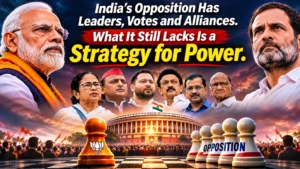
The 2024 election demonstrated that opposition coordination in some states could produce meaningful electoral outcomes. But the INDIA alliance is not a uniform national organisation. It is a collection of parties with different regional interests, political histories, ambitions and voter bases.
That is both its strength and its weakness.
Regional parties bring local credibility, organisation and knowledge that a national party may not possess. Congress brings a national footprint and a presence across multiple states. Other opposition parties have their own political constituencies and ambitions.
The challenge is to turn these advantages into a functioning electoral strategy.
Seat-sharing negotiations can become difficult when every party believes it deserves more constituencies. Leadership discussions can create friction. State-level partnerships may not translate into national-level cooperation. A common opponent does not necessarily create a common political vision.
The opposition could enter 2029 with a stronger arrangement than it had in previous elections—but only if it resolves these tensions before the campaign begins.
The missing ingredient: a credible alternative
Opposition unity is not, by itself, an electoral programme.
Voters need to understand what a proposed alternative government would prioritise. What would its economic approach be? How would it address employment, inflation, public services, infrastructure, welfare and investment? How would it manage the interests of parties that may disagree on important policy questions?
A coalition that is united against another political force may be less convincing than one that is united around a programme.
What could strengthen this scenario?
- Better constituency-level seat sharing
- Reduced vote splitting
- A credible national policy framework
- Stronger regional alliances
- Improved campaign coordination
- Leadership clarity
- Consistent communication
What could weaken it?
- Seat-sharing disputes
- Leadership rivalry
- State-level alliance breakdowns
- Contradictory campaign messages
- Party defections
- Lack of a common economic and governance vision
The opposition’s 2029 opportunity may be real. But its success will depend on whether it can turn arithmetic into political trust.

Scenario 3: Regional India Becomes the Deciding Factor
Delhi may set the narrative. States may decide the numbers.
Indian elections are often discussed through national leadership and national political narratives. But the country does not vote as a single political unit.
The political priorities of a voter in Tamil Nadu may differ considerably from those of a voter in Uttar Pradesh. Maharashtra’s political calculations are not identical to Bihar’s. West Bengal, Telangana, Karnataka, Andhra Pradesh and other states have their own leadership battles, political histories, party structures and voter expectations.
This is where the 2029 election could become particularly unpredictable.
The five largest states by population—Uttar Pradesh, Bihar, Maharashtra, West Bengal and Madhya Pradesh—carry substantial electoral weight. Their political outcomes, along with developments in other large and competitive states, can significantly affect the national seat calculation.
A national campaign may be dominated by one issue, but constituencies could be influenced by entirely different questions.
In one state, the strength of a regional leader may matter more than national messaging. In another, alliance arrangements may determine whether votes translate into seats. Elsewhere, local candidate selection, community representation, development concerns or dissatisfaction with state-level governance could become decisive.
The danger for national parties is assuming that momentum in one region will automatically travel to another.
Regional parties, meanwhile, could play a much larger role than their national vote share suggests. Their ability to concentrate support in specific states or constituencies can make them essential to government formation even when they have limited presence elsewhere.
This scenario does not require regional parties to become national parties.
It only requires them to win where their political influence is concentrated.
What could strengthen this scenario?
- Strong state-level leadership
- Regional party resilience
- Local dissatisfaction with national or state governments
- State-specific alliances
- Candidate popularity
- Political issues unique to individual states
What could weaken it?
- National campaign consolidation
- Stronger national-party organisation in regional areas
- Regional alliances breaking apart
- State-level political realignments
If 2029 becomes a collection of separate state battles, national political observers may find that the most important developments are happening far away from the national campaign stage.
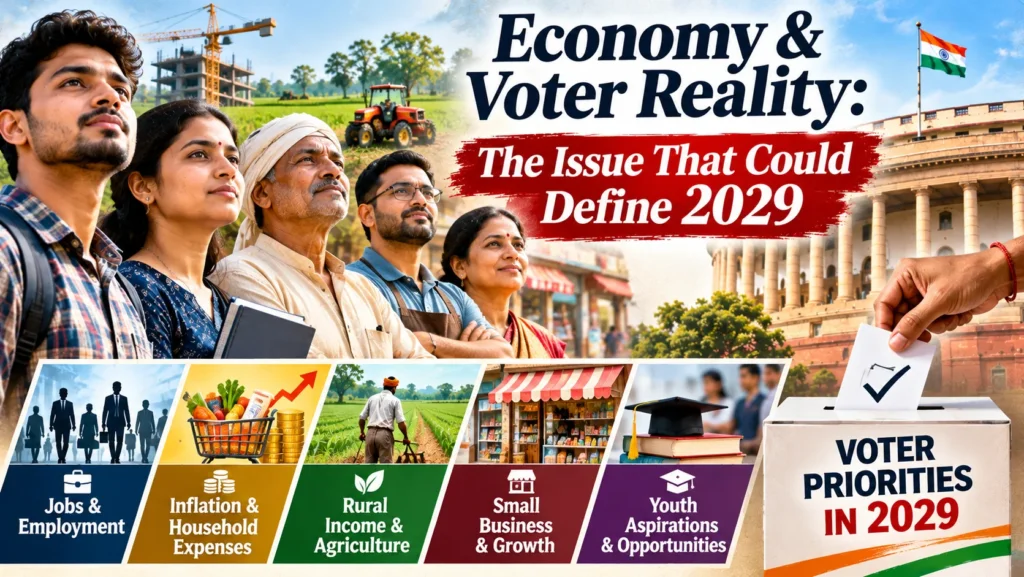
Scenario 4: Economic Reality Overtakes Political Narratives
When the household economy becomes the election’s central question
Political narratives can be powerful. Leadership can be powerful. Ideology can be powerful.
But household economics has a way of forcing its way into the political conversation.
By 2029, voters will have experienced several more years of economic changes. The political importance of those changes may depend less on national headline growth and more on how households experience them.
Can a young graduate find stable employment? Are wages keeping pace with expenses? Is a small business able to grow? Can rural households maintain income? Are families spending more on essential goods and less on discretionary purchases? Is economic opportunity becoming more accessible—or increasingly concentrated?
These are the questions that could quietly reshape an election.
Economic growth and personal economic confidence are not always the same thing. A country may record strong macroeconomic performance while sections of its population remain concerned about job quality, affordability, income stability or the cost of starting a business.
This gap could become politically significant.
The ruling alliance may argue that infrastructure, investment, economic reforms and national development are creating long-term opportunities. The opposition may focus on employment, household pressures, inequality or the gap between economic growth and individual experience.
Both arguments could become central to the election.
The outcome may depend partly on which narrative voters find more credible—and whether they feel the economy has improved their personal circumstances.
The economic indicators worth watching
Employment: Job creation, job quality, labour-force participation and opportunities for young people.
Household purchasing power: Food prices, household expenses, wages and the ability to save.
Rural economy: Farm income, agricultural costs, rural employment and local demand.
Small businesses: Credit, demand, taxation, operating costs and business confidence.
Youth aspirations: Education, skills, first jobs, mobility and economic independence.
What could strengthen this scenario?
- Persistent household cost pressures
- Employment becoming a central political issue
- Weak income growth in important voter segments
- Rural or urban economic dissatisfaction
- A credible opposition economic agenda
- Major economic changes that affect voters directly
What could weaken it?
- Broad-based improvements in household income
- Strong job creation
- Visible gains in living standards
- Continued public confidence in the government’s economic direction
- Economic concerns being overshadowed by other political issues
The election may not be decided by economic growth figures alone. It may be decided by whether voters believe their own economic future is improving.
Scenario 5: An Unexpected Political Realignment Changes the Entire Equation
The scenario nobody can properly model today
The most dangerous mistake in analysing an election years in advance is assuming that the political environment will remain recognisable.
Indian politics has repeatedly demonstrated that alliances can change, political organisations can split, leadership can rise unexpectedly, and regional movements can alter the electoral balance.
By 2029, the political landscape could look very different from today’s.
A major leadership transition could change the priorities of a party. An alliance that appears stable today may become difficult to sustain. A regional party could emerge stronger than expected. A new movement could mobilise voters around an issue that currently receives limited attention.
Even an unexpected governance issue or economic development could fundamentally change the direction of the campaign.
The point is not to invent a future crisis or speculate about political events without evidence.
The point is to recognise that India’s electoral system is highly responsive to political changes that may not be visible years in advance.
A political party’s current strength is not a permanent asset. An alliance’s current arrangement is not a guarantee of future cooperation. A leader’s current popularity is not necessarily a forecast of their political position three years later.
This scenario is particularly important because it cannot be assigned to one party.
Unexpected realignments could strengthen the ruling alliance, create new opportunities for the opposition, empower regional parties or produce a political outcome that does not fit today’s assumptions.
What could strengthen this scenario?
- Major leadership changes
- Party splits or mergers
- New political movements
- Unexpected regional shifts
- A significant national issue
- Changes in alliance structures
- Political mobilisation around a previously secondary issue
What could weaken it?
Stable party structures, consistent voter preferences and the absence of major political disruptions may reduce the likelihood of a dramatic realignment.
The most important lesson is simple: the political map of today is not necessarily the political map on which India will vote in 2029.
What Could Decide the Election Across All Five Scenarios?
The scenarios are different, but several political forces run through all of them.
The leadership question
Will 2029 be a leadership election?
The answer may depend on how effectively political parties present leadership as a combination of experience, credibility, performance and future direction.
Leadership can influence voters, but it cannot always overcome local political realities. Even a strong national leader may depend on candidate selection, state organisation and alliance partners to convert support into seats.
The challenge for every major political formation will be to make leadership relevant at both the national and constituency levels.
The mathematics of 543 constituencies
India’s first-past-the-post electoral system makes the distribution of votes crucial.
Winning a constituency requires more than receiving a significant share of votes nationally. Parties must win individual contests. A party with geographically concentrated support may convert votes into seats more efficiently than one with a larger but widely distributed vote share.
The 2024 result offered a reminder of this distinction: the BJP retained a substantial national vote base, but its seat tally declined significantly from 2019.
This is why alliance arrangements, candidate selection and regional strategy may be decisive in 2029.
The election could be won or lost through relatively small shifts across a number of competitive constituencies rather than one dramatic national swing.
The voter who has not decided yet
Political parties frequently focus on their loyal voters. But the election may be shaped by those who are less firmly attached to a political identity.
These voters may evaluate parties through a combination of personal economic circumstances, leadership, local candidates, welfare programmes, governance, political messaging and issues that emerge during the campaign.
First-time voters could bring new expectations. Urban voters may prioritise different concerns from rural voters. Women voters may respond to a combination of economic, welfare, safety, representation and local issues. Small-business owners may evaluate the political environment through operating costs, demand, credit and regulatory conditions.
None of these groups is politically uniform.
The analytical challenge is to understand how priorities change—and whether parties recognise those changes before the campaign begins.
The organisation behind the leader
Election campaigns are often remembered through speeches, rallies and personalities. Elections, however, are also organisational exercises.
Candidate selection, booth-level mobilisation, local leadership, voter outreach, campaign coordination and alliance management can determine whether political popularity becomes an electoral victory.
The party that looks stronger on television may not necessarily be stronger in the constituencies that matter.
The party that understands the local contest, selects the right candidate and mobilises its voters effectively may outperform broader political expectations.
The Signals Worth Watching Before 2029
These indicators will not predict the election on their own. Together, however, they may reveal how the political equation is changing.
State election results
Watch whether national parties gain or lose ground in important states—and whether state election outcomes reflect local issues or broader national political sentiment.
Alliance negotiations
Seat-sharing discussions, coalition stability and regional party positioning could reveal whether political forces are preparing for cooperation or competition.
Party organisation
Changes in leadership, booth networks, campaign structures and candidate selection may reveal which parties are preparing more effectively for the national contest.
Economic sentiment
Employment, household expenses, rural income, business confidence and economic opportunity may influence voter priorities.
Parliamentary performance
How parties use Parliament, develop policy arguments and respond to national issues could influence their public credibility.
Voter mobilisation
Watch how parties engage younger voters, women, first-time voters and communities whose political preferences may be changing.
The value of these signals lies in their combination. A single state election may not reveal a national trend. A party split may not change the national equation. A change in economic sentiment may not immediately translate into votes.
But when several indicators move in the same direction, the political implications become harder to ignore.
Five Possible Elections. One Uncertain Outcome.
The 2029 Lok Sabha election is too far away for confident predictions—and too important to ignore.
The ruling alliance has the advantage of organisation, political experience and an established national presence. The opposition has the opportunity to build on its electoral gains, strengthen alliances and present a more credible alternative. Regional parties retain the potential to influence outcomes in states where national political narratives do not always dominate.
The economy could become a decisive political force. Leadership could change the campaign. Alliances could reshape constituencies. And an unexpected development could disrupt every assumption being made today.
Perhaps the most important question is not which party is ahead in the political conversation at this moment.
It is which political forces will be better prepared when the election actually arrives.
India’s 2029 election could be a contest of continuity, a battle for change, a regional political verdict, an economic referendum or a realignment nobody currently expects.
It could also be a combination of all five.
The mistake is to confuse today’s political position with tomorrow’s electoral outcome.
The election has not yet been decided—not by opinion, not by momentum, and certainly not by predictions.
The political story of 2029 is still being written.